Maths and statistics, Python, cleaning data, visualisation and machine learning — the whole path from data to a decision, worked on real datasets.
In this category
Data Science and AI
Questions about admission, fees or batch timing? Tell us and we will get in touch.
From CRUD to indexing, stored procedures, triggers, views and performance tuning — the database knowledge any developer role expects.
Authentication, the Realtime Database, Firestore, Storage, Hosting and Cloud Functions — how to stand up a complete application without writing a back end.
Statistics, Python and visualization — the route from raw data to decisions, completely free.
From the document model to aggregation and indexing — basics to advanced, with practice at every step.
A one-week classroom course on the first core concepts of the Apache Airflow 3.4 documentation: the architecture overview, Dags, Dag runs, tasks and operators. This course prepares for no exam.
A short classroom course in using Excel to answer questions with data. It follows the areas of Microsoft's own Excel training: getting started, formulas and functions, formatting data, importing and analysing data, analysing with PivotTables, and collaborating on a workbook. This course prepares for no exam.
A one-week classroom course on three programming guides of the Apache Spark 4.3 documentation: the quick start, PySpark, and Spark SQL, DataFrames and Datasets. This course prepares for no exam.
A lab-based classroom course in data engineering on AWS. It follows the four domains of the official DEA-C01 exam guide: data ingestion and transformation, data store management, data operations and support, and data security and governance.
A six-week classroom course that follows the sections of the Apache Kafka 4.4 documentation: introduction, quickstart and use cases, then key concepts, the APIs, configuration, design, operations, security, Kafka Connect and Kafka Streams. You run a small cluster and build a pipeline on it. This course prepares for no exam.
A one-week classroom course on the tutorial chapter of the MySQL 8.4 reference manual: connecting to the server, entering queries, creating and using a database, getting information about databases and tables, batch mode and examples of common queries. This course prepares for no exam.
A two-day classroom workshop on the getting-started page of the Polars user guide: installing, reading and writing data, expressions and contexts — select, with_columns, filter and group_by — and combining dataframes by joining and concatenating. This workshop prepares for no exam.
A six-week classroom course built on four libraries' own guides: NumPy's basics for beginners, the Matplotlib quick start, the seaborn tutorial and Streamlit's basic concepts. You go from arrays, to charts you control in detail, to statistical charts, to a small interactive data app. This course prepares for no exam.
A two-day classroom workshop on one chapter of the PostgreSQL 18 documentation's Server Administration part, Backup and Restore, with routine database maintenance beside it. You take a backup, lose the database on purpose, and restore it. This workshop prepares for no exam.
A one-week classroom course on one part of Microsoft's PL-300 outline, creating model calculations by using DAX: aggregation measures, the CALCULATE function, time intelligence, and calculated columns and tables. It covers part of one skill area and prepares for no exam on its own.
A one-week classroom course on the Matplotlib quick start guide: the parts of a figure, the two coding styles, styling, labelling, axis scales and ticks, colour-mapped data, and working with several axes. This course prepares for no exam.
A one-week classroom course on the creating-reports part of Microsoft's PL-300 outline: choosing and formatting visuals, slicing and filtering, themes and conditional formatting, and laying out a report page. It covers part of one skill area and prepares for no exam on its own.
A classroom course in R, the language built for statistics. The modules follow the chapters of the R project's own manual, An Introduction to R (R 4.6): numbers and vectors, objects, factors, arrays and matrices, lists and data frames, reading data from files, probability distributions, loops and conditional execution, writing functions, statistical models, graphical procedures and packages. This course prepares for no exam.
A two-day classroom workshop on the core data types in the Redis documentation: strings, lists, sets, hashes, sorted sets and streams. For each one you run the commands and see the job it suits. This workshop prepares for no exam.
A one-week classroom course on NumPy's own guide, the absolute basics for beginners: creating arrays, shape and reshaping, indexing and slicing, array operations, broadcasting, random numbers, and saving and loading data. This course prepares for no exam.
A classroom course in the SQL language, taught on PostgreSQL. The modules follow Part II of the PostgreSQL 18 documentation, "The SQL Language": syntax, data definition, data manipulation, queries, data types, functions and operators, indexes, full text search, concurrency control and performance tips. This course prepares for no exam.
A one-week classroom course on the PivotTable and import-and-analyse areas of Microsoft's own Excel training. You import a dataset, prepare it, summarise it with PivotTables and present the result. This course prepares for no exam.
A lab-based classroom course in running PostgreSQL in production. The modules follow Part III of the PostgreSQL 18 documentation, "Server Administration": server setup and configuration, client authentication, roles, routine maintenance, backup and restore, high availability and replication, monitoring, and the write-ahead log. This course prepares for no exam.
A short classroom course in scheduling data work reliably. The modules follow the core concepts of the Apache Airflow 3.4 documentation: architecture, Dags and Dag runs, tasks and operators, sensors, TaskFlow, XComs, variables and params, executors, backfill, and debugging Dags. This course prepares for no exam.
A one-week classroom course on the first skill area of Microsoft's PL-300 outline, prepare the data: connecting to sources, profiling and cleaning, and transforming and loading. It covers one skill area of four and prepares for no exam on its own.
A classroom course in turning business data into reports people can act on. It follows the four skill areas of Microsoft's PL-300 study guide (skills as of 20 April 2026): prepare the data, model the data, visualise and analyse the data, and manage and secure Power BI.
A classroom course in processing data too large for one machine. The modules follow the programming guides of the Apache Spark 4.3 documentation: PySpark, Spark SQL and DataFrames, the RDD programming guide, Structured Streaming, MLlib, Spark Connect and Declarative Pipelines. This course prepares for no exam.
A three-month classroom course that follows Microsoft's study guide for Exam DP-600, Implementing Analytics Solutions Using Microsoft Fabric: planning and managing an analytics solution, preparing and serving data, semantic models, and exploring and analysing data. The exam fee and the Fabric capacity used after the course are not included.
A one-week classroom course on the CRUD operations chapter of the MongoDB manual: create, read, update, delete and bulk write. You work in the shell against a practice database, one operation a day. This course prepares for no exam.
A one-week classroom course on the first two chapters of the open textbook OpenIntro Statistics: introduction to data and summarising data. You learn the kinds of data, how studies are designed, and how to describe a dataset with numbers and charts. This course prepares for no exam.
A three-month classroom course that follows Microsoft's study guide for Exam DP-300, Administering Microsoft Azure SQL Solutions (skills measured as of 27 October 2026): data platform resources, a secure environment, monitoring and optimisation, automation, and high availability and disaster recovery. The exam fee is not included.
A lab-based classroom course in data engineering on Microsoft Fabric. It follows the three skill areas of the DP-700 study guide: implement and manage an analytics solution, ingest and transform data, and monitor and optimise an analytics solution. The exam expects SQL, PySpark and KQL.
A two-day classroom workshop on the basic concepts page of the Streamlit documentation: the development flow, the data flow, displaying data, charts and maps, widgets, layout and showing progress. This workshop prepares for no exam.
A one-week classroom course on the formulas and functions area of Microsoft's own Excel training. You learn how formulas and cell references work, then the functions used every day for totals, conditions, lookups, text and dates. This course prepares for no exam.
A classroom course in the statistics every data role relies on. The nine modules are the nine chapters of the open textbook OpenIntro Statistics: introduction to data, summarising data, probability, distributions, foundations for inference, inference for categorical data, inference for numerical data, linear regression, and multiple and logistic regression. This course prepares for no exam.
A two-week classroom course on the first seven chapters of the R project's manual, An Introduction to R: preliminaries, numbers and vectors, objects, factors, arrays and matrices, lists and data frames, and reading data from files. This course prepares for no exam.
A one-week classroom course on the seaborn tutorial: the plotting functions, the data structures seaborn accepts, visualising statistical relationships, distributions and categorical data, regression fits, multi-plot grids, figure aesthetics and colour palettes. This course prepares for no exam.
A six-week classroom course that follows Microsoft's study guide for Exam DP-900, Microsoft Azure Data Fundamentals (skills measured as of 21 July 2026): core data concepts, relational data on Azure, non-relational data on Azure, and analytics workloads. The exam fee is not included.
A two-week classroom course on one chapter of the PostgreSQL 18 documentation — Queries — with the data-manipulation chapter beside it. You learn to select, filter, sort, join and group, and to insert, update and delete safely. This course prepares for no exam.
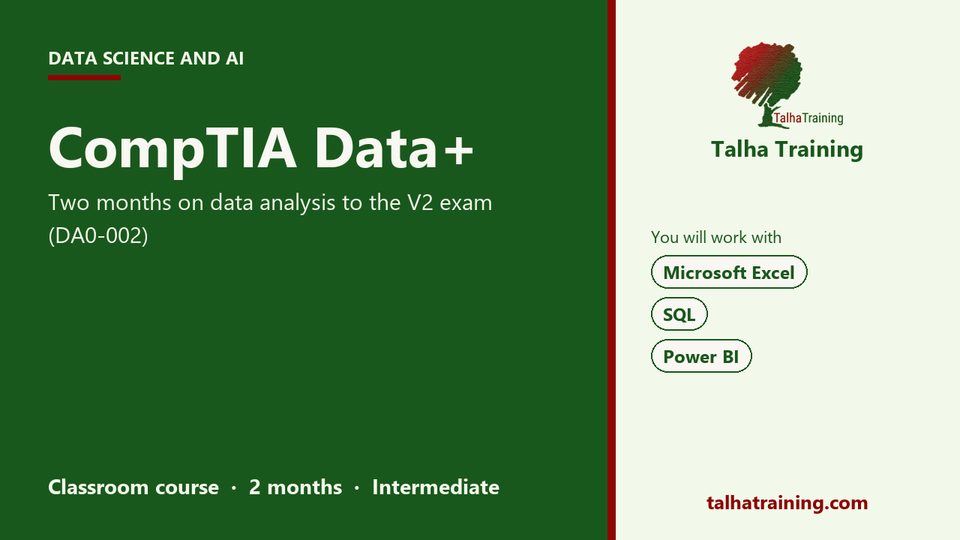
A two-month classroom course that follows the five domains of CompTIA Data+ V2 (DA0-002, launched 14 October 2025): data concepts and environments, data acquisition and preparation, data analysis, visualization and reporting, and data governance. The exam fee is not included.
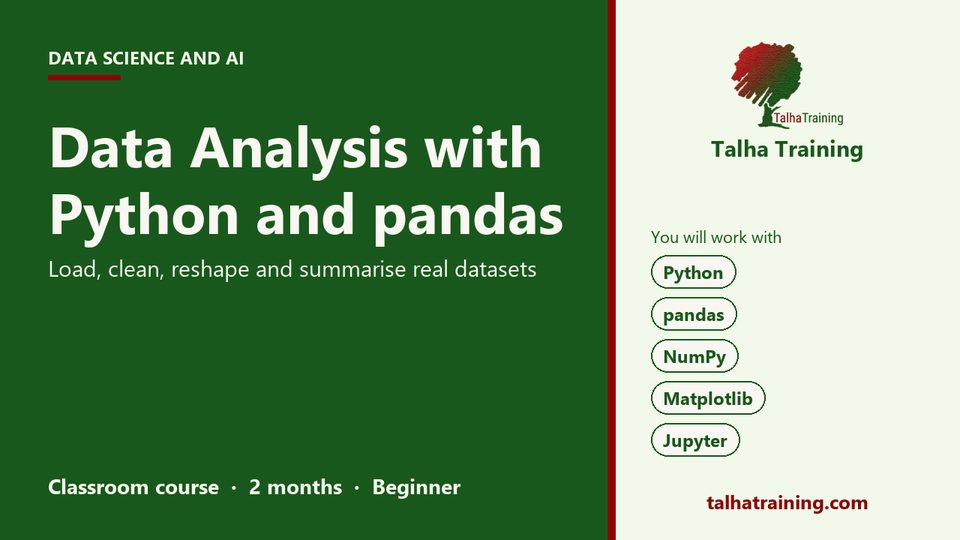
A classroom course in analysing data with code instead of a spreadsheet. The modules follow sections of the pandas user guide: data structures, reading and writing files, indexing and selecting, missing data, merging and joining, reshaping and pivot tables, group by, time series and chart visualisation. This course prepares for no exam.
A one-week classroom course on the opening sections of the pandas user guide: 10 minutes to pandas, intro to data structures, essential basic functionality, IO tools, and indexing and selecting data. For people who already know a little Python. This course prepares for no exam.